

Electronic Mail | Sending Electronic Mail


Sending Electronic Mail
Sending email is easy once you've gotten past a bit of initial setup and configuration. You can, for instance, configure many browsers to handle your email. (Of course, the details vary with browser and operating system; check your browser's help files if you want to access email this way.) In this example, however, we describe using a web email system from Yahoo, one of the popular portal sites. In this case, you'd don't have to configure anything about your browser; you only need to go to the web site and supply a bit of information to have your email account activated. Many people use web email because it is easy to set up and you can access your mail from any computer that has a browser and an Internet connection.
If you have a web email account on some other site, the following examples and screens will not be exactly the same as the ones you will see there, but fundamentally they should be similar.
To send email, go to the Web site that hosts your email account and
log in. You should see a link or button that allows you to create a new message. On the Yahoo site, for example,
there is a Compose link in the left frame menu bar. Click this link; your
screen should then look something like this:
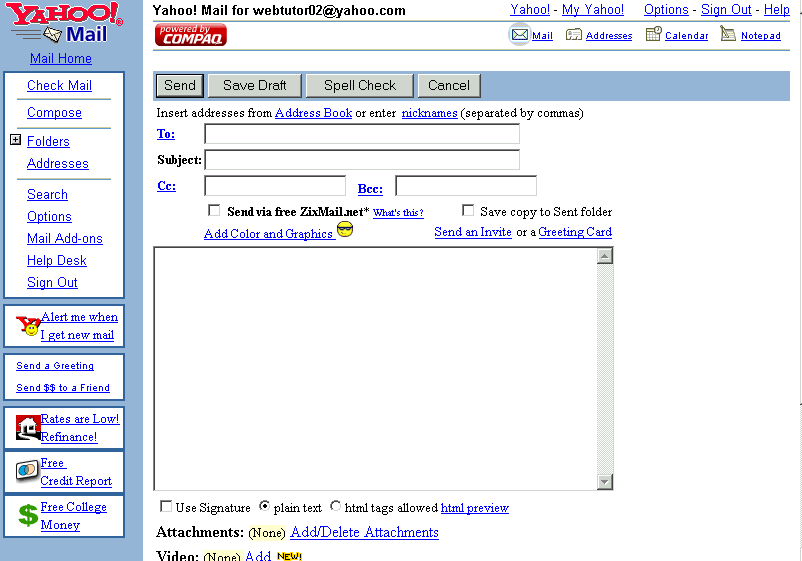
As you can see, in this figure there are several windows into which you may enter information. To illustrate what goes in those windows, we are going to send a mail message to the President of the United States.
Yes, the President has an email address! It is
And so does the Vice-President; it is
How do we know? Well, trust us for now; we'll find out how to locate email addresses a little later.
Now to create and send an email message, we do the following on the message composition page:
- Enter the subject of your message into the "Subject" window. You don't have to
put a subject, but it helps in keeping track of multiple messages to or from
the same person. It is good practice to include one for all messages.
- Enter the email address of the person that you are sending
the message to in the "To:" field. For this example we are going to
send a message to the President, so enter
[email protected] Be sure to put the address exactly like this. The regular postal service may still deliver mail if you make a spelling mistake in the address, but most computers will reject email if even one character is wrong in the address.
- Enter the email address of any other person that you wish
to receive copies of the message. In this case, let's send a copy to
the Vice-President (in case the President doesn't have time to take
care of your request!), and let's send a copy to ourselves so we will
have a record of the message that we sent. So enter into the "CC:" field
[email protected], youraddress where youraddress is whatever your personal email address is. ("CC:" stands for "Carbon Copy", from the old days when people used mechanical typewriters with carbon paper for copies and rode around in covered wagons!)
Notice that in this case we use commas to separate multiple addresses. Entries in the "CC:" field are optional (you don't have to send a copy to anyone), but you must enter an address in the "To:" field, since it wouldn't make much sense to send a message without an address for the primary person the message is for! The distinction between the primary recipients and those receiving a CC: is for human sensibilities. In either case, the computer sends the email message to the address listed. The only difference is where the recipient's address will be printed in the mail header when it is read.
- Now type whatever you wish to say in the message into the main window
area, generally the largest text entry area on the composition page.
At Yahoo the
lines will wrap automatically when you come to the edge of the
field, and if you need more space, the window will scroll down automatically.
- You may edit any of the fields in the mail window at any time before sending
the message by using the mouse to position the cursor and inserting new text or
erasing text with the "delete" key.
- If you wanted to attach a file to the mail message (for
example, a file with some text, or even a file with your picture) you
could do so by clicking on the Add/Delete attachments link. However,
we will assume that you are sufficiently famous that the President does
not need to see your picture, so we won't attach anything to this message.
Your composition page should now look something like the
figure below.
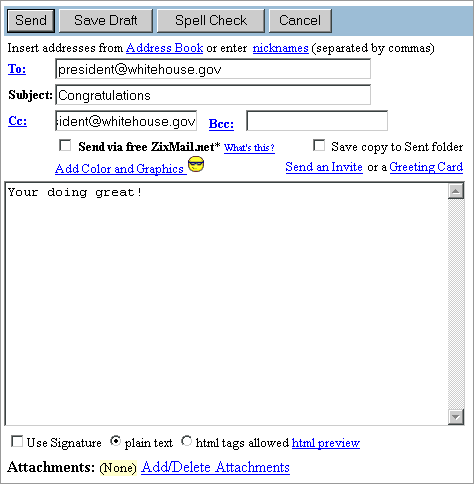
- When you are satisfied with your message, click the "Send" button at the left end of the toolbar to send the message.
That's it! If you have not made a mistake in typing in the addresses, you have just sent an email message to the President and copied it to the Vice-President. You have also sent a copy to yourself, so you should be receiving an email message very shortly from yourself and, we hope, a reply from the President and Vice-President.
Since it looks like we are going to be receiving some mail, we now need to learn how to read incoming email messages.